
Ash Dieback in the UK: What It Means for Your Trees and When Action Is Needed
Ash trees are a familiar and much-loved part of the British landscape, but in recent years, a serious disease known as ash dieback has become a major concern for homeowners, landowners, and local authorities across the UK.
Ash Dieback in the UK: What It Means for Your Trees and When Action Is Needed
Ash trees are a familiar and much-loved part of the British landscape, but in recent years, a serious disease known as ash dieback has become a major concern for homeowners, landowners, and local authorities across the UK.
At Wild About Trees, we regularly help customers identify and manage affected trees safely and responsibly. Here’s what you need to know.
What Is Ash Dieback?
Ash dieback is a disease caused by a fungus called Hymenoscyphus fraxineus. It affects ash trees by blocking their water transport systems, leading to leaf loss, crown dieback, and, in many cases, eventual death.
Since it was first identified in the UK, it has spread widely and is now present across most regions.
How to Identify Ash Dieback
Recognising the signs early can help you take appropriate action. Common symptoms include:
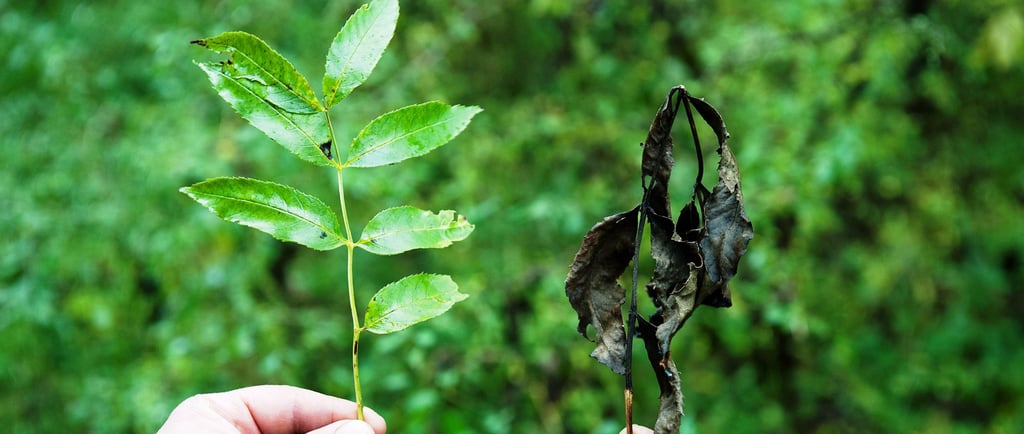
Leaves developing dark patches and wilting
Early leaf loss during summer
Dieback of shoots and branches in the crown
Lesions or cracks in the bark, often where branches meet the trunk
Epicormic growth, which is new shoots growing from the trunk
Not all trees decline at the same rate. Some may survive for years, while others deteriorate quickly.
Is Ash Dieback Dangerous?
The disease itself does not directly pose a risk to people, but infected trees can become structurally unstable over time. As branches weaken and die, they may fall unexpectedly, especially during strong winds or storms.
This is particularly important if the tree is located near:
Roads or public footpaths
Buildings or gardens
Play areas or schools
Do You Have to Remove an Infected Tree?
Not always. There is no legal requirement to remove an ash tree simply because it has ash dieback. However, action may be necessary depending on its condition and location.
Here are three key points to understand:
Assessment Is Crucial
Each tree should be assessed individually. Some ash trees show a level of tolerance and may continue to live for many years, while others become unsafe quite quickly.
A professional inspection will determine whether the tree can be retained, reduced, or needs removal.
Safety Comes First
If an infected ash tree poses a risk to people or property, work can and should be carried out at any time of year.
Unlike bird nesting restrictions, safety concerns take priority when dealing with hazardous trees.
Tree Work Can Still Be Carried Out
Tree work, including pruning or removal, can still go ahead, provided it is done safely and in line with any local regulations such as Tree Preservation Orders (TPOs) or conservation area rules.
It’s always best to check before work begins, and we can help guide you through that process.
Our Approach
At Wild About Trees, we take a practical and responsible approach to ash dieback:
Carrying out thorough inspections
Providing honest advice on whether to retain or remove trees
Undertaking safe and efficient tree work
Ensuring compliance with local regulations
We understand that losing a tree can be difficult, but safety and long-term management are always our priority.
Need Advice on an Ash Tree?
If you’re concerned about a tree on your property, don’t wait until it becomes a problem. We’re here to help you assess the situation and take the right steps.
In summary, ash dieback is widespread across the UK, but not all trees need immediate removal. With the right assessment, you can make informed decisions while ensuring your property remains safe.
Get in touch today to arrange an inspection or discuss your options.
Services
Site Map
Contact Us
Phone: 07752317220
Email: martyn@wildabouttrees.com
Areas We Cover
Penrith, Keswick,
Cockermouth, Wigton,
Ambleside,
Windermere, Eden
Valley, Shap, Carlisle,
Appleby, Kirby Stephen
Business Hours
Mon - Sun
8:00 - 19:00